The Best Chocolate Chip Cookies (EVER)

24 Jun

I wanted to bake some cookies at M’s house, but I was worried that if I used the heavy equipment needed for a good cookie dough (electric mixer for example to cream the butter), I would wake the baby! So I looked online and found this recipe by Cook’s Illustrated magazine, which runs the brilliant tv show America’s Best Kitchens. They are truly amazing cooks, and combine artistry with a certain technical chemical mastery.

Anyway. I adapted these cookies a little bit (as all cooks will) but kept with their basic formula. This is a no mixer cookie, and makes the softest, most pliable, “lemak” dough I have ever used. And it takes like 15 minutes to put together.

And seriously? Amongst the best chocolate chip cookies I have ever tasted. I have made them probably about 4 – 5 times with AngelKitten and Sawa during this World Cup, and people are obsessed by them. They get cravings, and beg us for just a few from our secret stash. We have shared them with friends and family, and just keep getting asked for more. I was thinking of making other things – a berry crumble or the most phenomenal carrot cake in the whole wide world – but for ease of making and for pleasure given, these just cannot be beaten. Hot from the oven they are … well, orgasmic is a word I would use. Enjoy!

Just a few notes:

1. Depending on the “rise” please adjust your baking soda. First batch I used about a teaspoon, and they were a tad thicker than second batch where I used about 1/2 teaspoon. Depends on your preference really.

2. Use best quality chocolate (NOT cooking chocolate, and not chips if you can avoid it)… Get good chocolate, and chop it up. ALWAYS makes a cookie taste better.

The Perfect Chocolate Chip Cookie via Cooks Illustrated

  • 1 3/4 all purpose unbleached flour
  • 1/2 – 1 tsp baking soda
  • 14 tablespoons butter, divided into 10 tablespoons + 4 tablespoons (I used salted)
  • 1/2 cup light brown sugar
  • 3/4 cup dark brown sugar, well packed
  • 1 tsp table salt
  • 2 – 4 tsp vanilla extract
  • 1 large egg
  • 1 large egg yolk
  • 2 cups chocolate chunks – when I first made these I used Callebut white + milk cut off a block – now I use Valhrona buttons smashed up, a mix of dark (70%), milk (65%) and white.

Measure the flour in a measuring jug, add the baking soda (1/2 tsp for preference) and set aside.

Over high heat, in a large non stick skillet, melt 10 tablespoons of butter. Once melted, keep on heat, swirling constantly, until the butter has browned well, and is toasty and nutty. You want it browned and caramel-y and dark and gleaming, but not burnt. You will know from the smell, but be careful because it goes brown very quickly. The darker it gets (without burning) the more caramel notes you will have in your cookie – so be brave, but dont let it go over to the burnt and bitter side! Transfer the butter to a heatproof bowl (or even a large saucepan or pot!). Add the remaining 4 tsp butter (it will foam up) and using a wooden spoon, mix in until melted.

Add sugar, salt and vanilla and whisk until incorporated. Add egg and egg yolk, and whisk again.

This is VERY IMPORTANT

Let mixture stand for about 3 – 5 minutes, and then whisk again for about 30 seconds.

Continue to do this (letting mixture stand, and then briefly whisking) 3 times in total. You will see a remarkable difference in the mixture from when you started, to the final whisking. It will have set up, thickened, become almost stiff liquid caramel in consistency. Amazing.

The resting is key, so please do not think you can skip the above.

Using a spatula or wooden spoon, mix in the flour until just combined. Let rest for a minute or so, and then mix in the chocolate chunks. You will find you have the softest, silkiest cookie dough you have ever handled. Let rest for a few minutes while you heat up the oven to 375 degrees and line a cookie tin with parchment or baking paper.

You should be able to get 8 cookies (of 1 tablespoon balls each) onto the cookie tin. If you prefer larger cookies, go right ahead but reduce the number of cookies on the tin! They spread! This should make approx 32 smaller cookies or 16 larger.

Bake for 7 – 9 minutes, or until just browned on the edges. Take out of the oven and allow to cool for a few minutes (they will set up) before transferring to baking sheet.

Try and break at least one so you have some cook’s rights before theyre all devoured!

Roasted Peppers and Garlic

24 Jun
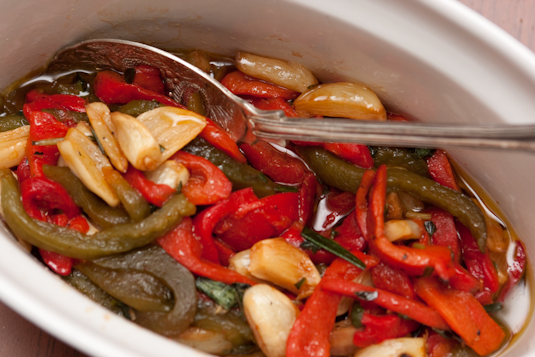
Two of my favourite things together – a marriage made in heaven! Roasted peppers are so sexy somehow. Slippery and sweet, tangy and juicy. The garlic adds a hint of muskiness and that scentsational aroma is mouthwatering. I often serve these as a starter – but you could add them to sandwiches, salads, soups, pasta. They are a wonderful standby to have in the fridge. A jar of these can take you to wonderful culinary heights! I made them for a dinner the other week, and they were lapped up by the hungry hoards. They are satisfying, easy to make (fun too if you like playing with fire), and their taste is much more complex and deep then the rather minimal effort expended.
  • 4 – 6 red peppers
  • 1 or 2 green peppers
  • Paper bag
  • Tongs
  • Fire source
  • Cloves of garlic
  • Good olive oil (Extra Virgin if you have it)
  • A dash of balsamico if you have it
  • Fresh oregano or rosemary or thyme
  • Sea salt

Make sure you have access to a paper bag.

Basically you want to take the peppers, and char them over a heat source (I usually do this on the stove top) until they are completely blackened and burnt.

Use the tongs to rotate the peppers over the flame source. BE CAREFUL. They will pop and fizz and spit. Keep watch over them at all times.

When they are completely blackened, pop them in the paper bag, and twist the opening to ensure a good seal. When I made this recipe, I used a paper shopping bag and just folded over the top a couple of times. The peppers will steam in the paper bags and soften. After about 20 – 30 minutes, the peppers will be ready for the next step.

Meanwhile, heat your oven to approximately 180 C.

Put your garlic cloves in a small baking tray, and sprinkle liberally with olive oil and sea salt. Pop them in the oven and roast until caramelized, about 15 – 30 minutes depending on your oven.

Once the peppers are lukewarm, take them out from the paper bag, one at a time. Peel the peppers. The blackened skin should come straight off, but if you have problems, use a little strip of paper towel to rub off any pesky bits.

You should have some intensely deeply coloured smokey peppers ready for anything you want to throw at them!

Once your peppers have been peeled, core them, throw away the seeds, and cut away the stringy inner bits, and slice them in thin strips.

Put the sliced peppers in a bowl, and slick over with as much olive oil as your preference dictates. They will go all shiny and blood red or emerald green. A few drops of aged balsamico wont hurt either. Add a couple of teaspoons of fresh or a shake of dry herbs over this mixture.

Once the garlic has been roasted to your satisfaction (about 15 minutes or so – it will start to smell like roasted garlic) and is golden and soft, let it cool, slice it and add to the bowl. Don’t waste the olive oil either! Its been imbued with soft golden garlic scent and tastes – add this to your bowl of deliciousness too!

This keeps brilliantly in the fridge and is a magical addition to salads, sandwiches and pasta.

If youre serving as is, make sure you bring the mixture to room temperature before serving. The juice at the bottom of the bowl is phenomenal.

Photo copyright U-en Ng

A Food Revolution in the Bronx!

23 Jun

My sister sent this article to me – please read it! An amazing, wonderful, brilliant man – the dad of our friends from schooldays – is revolutionising the concept of local food in the Bronx. He is a man on a mission with an extraordinary heart, and a belief that things can be done – and the ability to implement one step at a time.

From the New York Times

For a Healthier Bronx, a Farm of Their Own

Stewart Cairns for The New York Times

Chris Riger, left, and Rebecca Radliff mulching at the farm.

By KIM SEVERSON

IT’S hard to imagine two places in New York State more different than the South Bronx and Schoharie County.

The South Bronx has 31,582 people per square mile. The county has 51.

Less than 2 percent of the people who live in the South Bronx are white. Schoharie County, about three hours straight north by car, is 95 percent white.

The South Bronx is home to four jails, two sewage plants and an untold number of subway rats. Schoharie County has 13,600 cows, 1,305 sheep, 291 hogs and several hundred farmers to tend those animals and grow vegetables and fruit.

Dennis Derryck, a 70-year-old mathematician and professor at the New School for Management and Urban Policy, has become the unlikely matchmaker between the two worlds.

Mr. Derryck, who lives in Harlem, is Schoharie County’s newest farmer. His spread is Corbin Hills Road Farm, 92 acres with a pretty farmhouse and a silo that needs a roof. It’s the cornerstone of a project linking the upstate rural and downstate urban through beets and berries, an effort to get healthy food into what is the poorest Congressional district east of the Mississippi.

Unlike others who have come to the South Bronx to solve social problems through vegetables, he is offering neither charity nor an outsider’s idea of what the neighborhood might want to cook. He’s developed a commercial community-supported agriculture plan (C.S.A.) that lets residents determine what they’ll get, with an enticing prize at the end for people who stick with it: a chance to own shares in the farm.

He started the project because, like others who have spent time looking at what people eat in the South Bronx, he became frustrated.

“If there is a food revolution, it’s not yet including the low income,” Mr. Derryck said. Every day, hundreds of thousands of pounds of produce travel through the South Bronx to the Hunts Point market, one of the world’s largest food distribution centers. Little of it is actually sold in the surrounding neighborhood.

The South Bronx has more health problems than any other part of New York, according to studies by the city health department. Many, like diabetes and obesity, are connected to diet. Mr. Derryck thought a community supported agriculture program rooted in the actual community could help.

In a traditional C.S.A. plan, people pay farmers at the beginning of a season for weekly deliveries of whatever grows on the farm. Last year, 18,000 New Yorkers participated in 80 such plans, according to the advocacy group Just Food. It’s a model that doesn’t translate well to poor neighborhoods, where handing over, say, $500 at one time with the promise that someone will send you a box of flowers, herbs and vegetables you probably don’t want isn’t a popular notion.

So he decided to turn the model on its head, giving plan members a say in what is grown, and, with the help of nonprofit groups, making it less expensive as well.

“Most people I talked with say, ‘Can I get enough food to feed my family,’ ” Mr. Derryck said. “They don’t want parsnips and thyme. They want 10 pounds of potatoes.”

He cajoled almost every person he has ever served with on a nonprofit board, raising $562,000. He also got a $300,000 bank loan. He bought the farm in February 2009, then went shopping for a farm manager, a tractor and a refrigerated truck for delivery in the Bronx. Once he pays off investors and the loan, which might take five years or more, he intends to pass shares in the farm to the members of the plan.

Mr. Derryck’s farm won’t be producing until August. And even then, it can’t grow enough to fill the boxes. So a small group of Schoharie County farmers have signed on, agreeing to offer vegetables and fruit at a discount to help Mr. Derryck make budget. Mr. Derryck thinks the plan can eventually generate $1.2 million a year for Schoharie County farmers, and expand its roster of supporters to include foster-care families and day care centers.

Richard Ball, who grows some of the finest carrots in the state as well as cardoons and haricots verts for restaurants like Daniel and Per Se, met with Mr. Derryck and decided the crazy professor from Harlem had a cause worth supporting. He also figured it could build business and upstate-downstate good will.

“If we simply got New York to be New York’s customer, we’d be in great shape,” he said.

Seven nonprofit groups in the South Bronx have signed on as sponsors, passing on shares to employees and clients, others offering some financial help and still others serving as the collection and distribution points. The first week, Mr. Derryck sold 171 shares. This week, it reached 228.

“Clearly, we have struck a nerve,” Mr. Derryck said.

People can pay $3.75 to $20 a week, depending on income, subsidies and share size. Members only have to pay for two weeks’ supply of food at a time, and they can use food stamps.

Judith Raphael signed up right away. She has spent the last seven years raising two children in the neighborhood and each summer hosts the Taking Back the Bad Rap of Hunts Point celebration.

Despite what critics who have never lived in the South Bronx might think, people really do want to eat fresh fruit and vegetables, she said. But the options are slim. At the bodega, you might find spotty bananas and potatoes. At the only grocery store within walking distance, the broccoli is usually yellowing, the apples soft and the lettuce packaged.

And it’s not cheap.

“By the time you bought everything you need for the household, you get to the vegetables and you just say forget it, you can’t afford it,” she said. “People might not buy a bag of oranges because it’s too expensive, but that doesn’t mean they don’t want to cook a good dinner.”

The boxes that showed up Thursday held such beautiful food that people couldn’t stop smiling.

There were pantry fillers like red potatoes, turnips and beets. But there was also plenty of pristine chard, crisp sugar snap peas and fresh oregano. And even though strawberries were too expensive for Mr. Derryck’s initial budget, each family got a box — the farmers’ gift to their new urban partners. “Right off the bat you want them to think they are making a right decision,” Mr. Ball said.

But all that glowing good will doesn’t mean the project is going to work. Life in the South Bronx just isn’t that easy, and people are skeptical. Many groups have parachuted in trying to fix things, using fashionable terms like food deserts and food justice.

The city-run Green Carts program, which has issued permits for 113 produce carts in the Bronx, rarely shows up in Hunts Point, residents say. And City Harvest comes by every few weeks to hand out about 20,000 pounds of fruit and vegetables, bringing along chefs like Eric Ripert to demonstrate how to cook vegetable fried rice.

Even Heather Mills, the former wife of Paul McCartney, sends her brand of nutrition into Hunts Point. In 2008, she donated $1 million to the Hunts Point Alliance for Children for fresh produce, and provides frozen vegan imitation chicken, fish and hamburgers from her food company, Meatless Meats. She is also donating money to the Corbin Hills Road Farm project.

But not everyone in the South Bronx is enamored with programs that aren’t home grown.

“It’s been like this hippie approach to food justice that starts to have this hand-out mentality,” said Zena Nelson, who started the South Bronx Food Co-op in 2007. The co-op, which Ms. Nelson recently left, has agreed to buy 25 shares of the Schoharie C.S.A. plan to provide food for its members.

She empathizes with Mr. Derryck, who has to juggle the demands of his agricultural enterprise as well as the competing dietary interests of a community with roots in West Africa, the Caribbean, the American South and Latin America.

“This community is going to be a tough one,” Mr. Derryck said. “If I blow it, I’m not getting a second chance.”

That’s why he thinks the project will sustain itself only if residents have an ownership stake. Once plan members take control of the farm, they can collectively decide to use their shares to reduce the price of their weekly take, and make other decisions about how the farm is run and what’s grown. He envisions farm camps and weekend visits.

But it’s a concept that can confuse supporters and plan members alike.

“I don’t even know what they are talking about,” said Juan Duncan, an immigrant from the Dominican Republic who has been unemployed since March. Still, when he saw a flier outlining the concept, he enrolled. He’s sick and tired of grocery store prices. “Five or six dollars for a little bunch of asparagus with a rubber band around it?” he asked incredulously.

That the plan did not offer plantains was his only regret. “But I understand why,” he said.

Nancy Biberman has been working with people in the South Bronx for nearly three decades. She is the founder and president of the Women’s Housing and Economic Development Project, one of the biggest partners in Mr. Derryck’s project.

“If you don’t understand what ownership of anything other than a television or a cellphone is, the notion of being a shareholder in a cooperative farm is a hard concept to understand,” she said. But at this point, anything that gets good food into the South Bronx is worth a try.

“You know how you throw the spaghetti against the wall and see what sticks?” she said. “We’ll throw all the vegetables against the wall and see what happens. The problems are so serious, it’s kind of unconscionable to not try everything.”

Memories of a Vegetarian Thanksgiving

23 Jun

A Thanksgiving for everyone – even the turkey!

M + I cooking together, for Z’s first Thanksgiving…

  • Honey glazed carrots
  • Green beans with crispy friend onions
  • Cornbread stuffing with jerusalem artichokes, mushrooms, kale, and dried cranberries
  • Cranberry honey whiskey sauce
  • Puff pastry roll with mushrooms and pine nuts
  • Garlic mash potatoes
  • Red wine onion gravy
  • Roasted butternut and sweet potato with a maple glaze
  • Berry crumble
  • Pecan pie
  • Red wine and honey poached pears dipped in bittersweet chocolate with vanilla ice cream

… and there are only 4 of us sitting down to dinner!

This was the first Thanksgiving I celebrated in my sister, M’s house in Washington DC. I was there helping to look after Z, my beloved niece. My sister is vegetarian too, and with the advent of her daughter, we found that she was pretty intolerant to milk and dairy products. So we held back on layering the butter everywhere, though we didn’t completely do without it. It was a sumptuous meal, redolent of the most beautiful produce of the season. The colors where phenomenal, and M’s non-vegetarian BSA and our TBH didn’t even miss the turkey!

One of these days, I will try and recreate it and post the recipes. But the menu itself is pretty phenomenal!

Asparagus Pesto

23 Jun

Astonishing, divine, food of the Goddesses. Bright green and tasting like spring. You can eat this right out of the bowl (my sister, M’s preferred consumption method), or spoon it over toast rounds for bruschetta, in a sandwich, or over pasta or couscous. Its so extremely good, it needs no accessories. This is one of my favourite meals because who knew that asparagus could be made into pesto – and who knew that this taste combination existed and was soooooooo goood?!

You will need (for about 3 – 4 cups):

  • 1 1/2 pounds (about 600 – 700 gms) asparagus
  • 1 cup pine nuts
  • 5 – 7 cloves of garlic
  • 1 cup grated parmesan
  • 1/2 cup (or more) extra virgin olive oil
  • juice of 1 lemon
  • Salt

First prepare your asparagus. Ensure that the tough woody bits have been snapped off – the asparagus will do the work for you if you just hold it and snap it near the bottom end. It will naturally break where the tough bit is – discard this. Chop the asparagus very roughly – 2 – 3 sections per asparagus. In a large pot of boiling, lightly salted water, blanch the asparagus till bright green. They need to be cooked, but not soft. Probably about 5 minutes or less. Just before you drain the asparagus, put a coffee mug in the boiling water, and remove a mugful, and keep aside. Drain, and set aside.

Meanwhile, in a shallow frying pan, toast the pine nuts (no oil or anything added) until golden and slightly browned. Use a spatula and keep stirring the nuts. Keep a watch – these go from light golden to toasted to burnt in a blink of an eye and you cant really save them when they burn. Set aside to cool.

Put all the asparagus and garlic into your food processor, and pulsing gently, start the machine. Add about half the olive oil in a steady stream. Add all the pine nuts, and pulse again, adding the rest of the olive oil. Add the parmesan and lemon and pulse again. If at any point the mixture gets too thick, add a little of the water you kept from the asparagus. Taste and adjust seasoning. You might need more oil or salt, or even parmesan.

I usually keep aside a few asparagus tips and serve this combined with angel hair pasta, with the tips for prettiness. Its delicious. And very good for you!!!

Hummus and Pita Chips

22 Jun

So easy to make, its sinful. And an incredible edible shot of protein for any meal. Best be careful though, people cannot stop eating this. You will be asked to make it again and again.

Hummus

  • 4 cups chickpeas (3 x 400 g cans or you can use fresh if you really want to – I do not see any appreciable difference between canned and fresh for this menu)
  • ½ cup – 1 cup water (use the water the chickpeas came in)
  • ½ cup tahini (sesame) paste
  • ¼ – ½ cup fresh lemon juice
  • ¼ – ½ cup (or more) extra virgin olive oil
  • 1 teaspoon of salt
  • 5 – 7 cloves of garlic, roughly chopped
  • Fresh parsley (optional)
This is so bloody easy its difficult to call it a recipe. Its important though that you try and use best quality ingredients – if canned, make sure the chickpeas are organic. If youre using fresh, stick the chickpeas in a pot of water overnight, and they will soften sufficiently so that when you boil them, it will be quick and easy.
Once all your ingredients are assembled, toss everything into the food processor. If you dont have one (and really, you should, to make this and wonderful things like pesto), you could use a handheld masher. I usually use the lower amount of everything, and then adjust accordingly.
Pulse (or mash). Taste. Adjust. Repeat as needed.
I like my hummus slightly rough – I love the texture of chunks of chickpea in this silken paste – but feel free to process until completely smooth. Its totally up to your sense of taste and pleasure.
Store in the fridge, in covered containers, with a thin film of olive oil on top. Please make this at least 1 day ahead (and up to 3) to enable all the amazing flavours to meld and ripen.
Bring to room temperature before you serve. Taste again and adjust lemon, salt and olive oil.
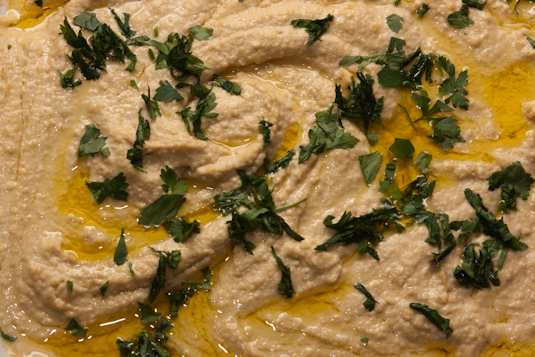
Serve sprinkled with some bright green parsley if you have some.

Pita Chips

Really simple to make, and so so so more-ish. One of my favourite things to make – and much better for you than any store bought chip because there are no additives of stabilizers or any of that crap.

  • 10 pita pockets (try and find local baked ones)
  • Olive oil
  • Sea salt
  • Bowl + brush
  • Scissors

Preheat oven to about 180 C

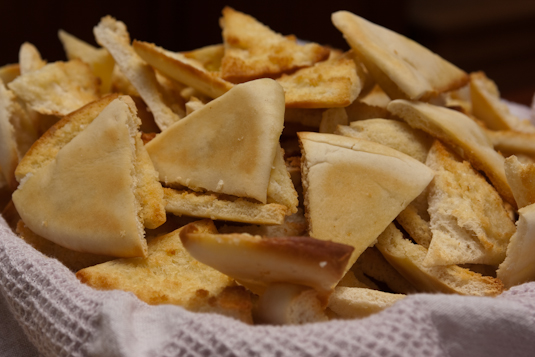
Using your scissors, cut the pita into eigths – big triangles – though if you prefer a modern art version, by all means cut them up randomly! If the pita bread is a pocket bread, you will need to split it as you cut it.

Pread into one layer over a baking pan. You will have to do this in batches so you might want to use 2 pans to allow one to go into the oven as the other gets prepped.

In a bowl, mix together extra virgin olive oil and sea salt, mixing well with your brush. The sea salt wont get completely absorbed by the oil, but you want it mixed well. (Note: you could add garlic, or parmesan if you want to get fancy, but honestly, I love the pure simple taste of olive oil and sea salt and pita).

Brush oil mixture over the chips gently.

Bake in the oven for a max of ten minutes. Keep watch as they burn quickly. They will be golden, crisp and delicious.

These keep for up to a week in an airtight container, but I have never gotten that far – they just get eaten!

All photos copyright U-en Ng


Vegetables a la Greque a la Karo

22 Jun

This is from a good friend of mine who has the same philosophy of cooking with love and passion, and as little harm as possible. She sent it to me as below, and I love her words, so I will let them be …

The original recipe is in “Mastering the Art of French Cooking” – and I think it’s volume 1.

It’s a one-pot method of turning your beautiful raw vegetables, which might otherwise become cloudy and dull in the fridge as you wait for another idea/opportunity to do something with them, into delectable little appetisers or salady thingies.

You can do it with any vegetable that has firm texture and flavour, as long as it does not need to be cooked before being eaten raw like potatoes and aubergines do. I find it a much more forgiving method than oven-roasting or grilling for cold salad veg.

I have used: courgettes, mushrooms, asparagus, pepper, celery, green beans, beetroot. Must do firm small tomatoes next.

Take your fresh and good vegetables and prepare them as if for salad – cut them cleanly and decoratively and uniformly.

Take a pot and put in it a scanty pint of water, the juices of one or two lemons, a cup of good olive oil, good salt, pepper, and garlic cloves finely chopped. Add any good herbs that you have to flavour your court-bouillon; bay, parsley, thyme, tarragon, fennel … I have added lemon rind too.

Bring to the boil and simmer your vegetables within until tender but still holding their firmness. Mushrooms will be tender in 5 minutes or less (depending on your slicing of them); celery could take 20.

Remove your vegetables, and leave to cool on a plate.

You could now poach another set of vegetables in the same pot. Or proceed:

Strain the court-bouillon and put it back to reduce by at least half. It will become a lovely flavoured smooth light emulsion.

Then cool it down and bathe your vegetables with it. And then eat as they are at room-temperature or cold from the fridge later. And consider dressing them further by adding garlic or fresh herbs or more garlic or more whatever to them.

(Last weekend, I had a cold hors d’oeuvre which included mushrooms with no added seasoning, green beans with lots of extra lemon and garlic, courgettes with chopped parsley and lemon )

Caramelised Onion Jam + Truffled Garlic Mash + Sauteed Mushrooms

21 Jun

When everyone else is eating meat, this is an incredibly rich, delicious, celebratory addition to the meal which you can share (if you really love them) with the carnivores.

Caramelised Onion Jam

(adapted from Softly Simmered Onions from the Silver Palate Good Times Cookbook)

These are so delicious. They can be added to so many things – mixed with a bit of cream in a pasta sauce, whizzed with vegetable broth for an amazing onion soup, on toast rounds with feta for an astounding bruschetta, or mixed with savoury custard in a brilliant tart / quiche. I like them as they are, tumbled over some creamy dreamy mash, with a few sauteed mushrooms for extra “meatiness”

  • 1 cup (2 sticks) butter
  • 8 cups sliced white and yellow onions
  • 1 cup dry red wine
  • 1/2 cup red wine vinegar
  • 1/2 cup brown sugar
  • 1 1/2 teaspoons freshly ground black pepper
  • 1/2 teaspoon salt
Melt the butter in a heavy large saucepan over low heat. While the butter is melting, prepare the onions: peel, cut in half lengthwise, and slice in thin half-rings. It helps if you keep the root intact, as an anchor.
Add the onions to the melted butter and stir well. Add all the wine, vinegar, sugar, pepper, and salt and mix to combine. Cover and cook slowly over low heat, stirring every 10 minutes or so, about 1 hour.
Remove the cover and cook 2 hours longer, stirring occasionally. You can decide how long you want to cook it – the onions will become thicker and jammier as you go. Just make sure you stir well through the bottom of the pan because it can burn. Makes about 4 cups, which will keep for at least 1 week, covered in the fridge.

Truffled Garlic Mash

Serves 8, though you can adjust as needed. The garlic will soften and sweeten when boiled with the potatoes and will add a whisp of fragrance and scent to this amazing creamy mix.
  • 9 large baking potatoes, peeled and cut into eighths
  • 8 cloves of garlic
  • 1/2 cup (1 stick) butter
  • 1/4 cup milk
  • 1/4 cup cream
  • Teaspoon or so jarred, canned or fresh truffles (you could use truffle oil in a pinch)
  • Salt and pepper

In a large saucepan, over high heat, boil enough water to just cover the potatoes. Once the water is at a roiling boil, add all the potatoes and garlic at once. They should take about 10 – 15 minutes to cook through. You want to be able to put the tip of a cutting knife through a slice of potato without any resistance.

While the potatoes are boiling, combine butter, milk, cream, truffles, and salt and pepper in a small saucepan. Bring to the boil and set aside to enable the truffle to infuse the butter and milk mixture with its heady scent.

When the potatoes have been cooked through, drain thoroughly, and place in serving bowl. Using a handheld masher, mash the potatoes, while adding the butter-milk-cream-truffle mixture. Taste for salt and pepper and adjust accordingly.

Sauteed Mushrooms

For each person, use 1 – 2 very large portobello mushrooms, depending on what else you are serving

  • 2 portobello mushrooms, peeled and sliced thickly
  • 1/2 tbsp butter
  • 1/2 tbsp olive oil or truffle oil
  • 1 tbsp balsamic vinegar (or port wine or red wine)
  • 1 tsp soy sauce
  • Salt and pepper to taste

You want to ensure the mushrooms are seared and not soggy. To do this, heat butter and olive oil in a large frying pan until quite hot, on high heat. Add the mushrooms, and stir to coat with butter. As the mushrooms start to let off some juice, add vinegar and then soy sauce. This will encourage some caramelisation and cause the mushrooms to sear against the heat of the pan. Taste and add salt and pepper as needed.

Serve each lucky vegetarian a large scoop of mash, topped with the caramelised onion jam, and sauteed mushrooms. Yum.

Another World Cup Sandwich + Strawberries

21 Jun

Tonight we watched and ate and laughed and played with cats. A good night was had by all. We needed simple, delicious, easy to make food, and I didnt really feel like cooking anything complex.

Grilled Tortilla Sandwiches

These grilled cheese and salsa soft tortilla sandwiches are really yummy, and can adapt to what you have in the house

For each sandwich you need:

  • 2 soft flat tacos/wraps
  • Salsa (bottled is fine)
  • Cheese (jack, cheddar, parmesan – whatever you feel like)
  • Soft butter
  • Mushrooms/avocado/tomatoes/sliced raw onions (one or a mix of all three)

Butter one side of a soft tortilla and place on a medium large frying pan, butter down. Place pan over medium heat, and spoon about 2 tablespoons of salsa over the tortilla. Grate cheese over the entire tortilla, and watch it melt . Add the additional filling – I used some quickly sauteed mushrooms – and butter the second tortilla. Place the tortilla over the sandwich fillings, butter side up, and flip it when you feel the bottom side has browned sufficiently. Fry for a minute or two on the second side, and slide onto a large plate. Cut into fourths. Give it a minute to cool down before demolishing.

Strawberries with balsamic

Unbelievably delicious. The acid in the balsamic breaks down the tender strawberry flesh, and creates a phenomenal sauce. More strawberry than the strawberriest strawberry – and so damn simple. Makes more than enough for four people.

  • Strawberries, hulled and sliced (about 2 – 3 cups)
  • 1 – 2 tablespoons balsamic vinegar (the older the better)

In a non reactive (glass preferably) bowl, slice strawberries. Pour over the balsamic, and using a spoon, stir well to ensure the vinegar completely coats the strawberries. Leave for at least half an hour in the fridge. A strawberry liquor will form – its so damn good, I cant tell you.

Serve strawberries spooned over vanilla ice cream or cold vanilla custard, with a little of the sauce drizzled over each serving.

Quick Hot Family Dinner in 5 minutes (honestly)

20 Jun

It will take you longer to read this recipe than it will to cook it. This is for when you wake up at 4am and cant believe how starving you are. When your tummy needs filling, and you just don’t want to do any work at all. You come home from work, or you’ve been chasing the kids all day, and all you want is sustenance. Or you come home after a night on the tiles (where does that phrase come from?!) and you need something starchy and yummy and simple to soak up all that booze. You can make it for more than 1 person, but its basic. Totally delicious, but basic. Once you have this little trick up your sleeve though, you will be making up excuses to eat it. Don’t try to dress it up. There really is no need.

  • 1 large bowl that you will eat out of
  • ½ cup couscous
  • ½ cup boiling water
  • Butter
  • Salt
  • Cheese (Cheddar + Parmesan may be? Whatever you have both that combo is superb)
  • Some frozen peas for colour (and veg) or some tomatoes

Boil some water. As it comes to the boil, put ½ cup of couscous per person in the bowl that youre going to eat out of. Remember that couscous swells, so make it double the size of the amount of couscous youre using.

Put a pinch of salt in with the couscous and mix it all up with a fork. Add some butter to the couscous (may be about 1/2 teaspoon per person or more as you wish, and as your arteries can handle!)

Pour the ½ cup of boiling water over the couscous and cover (I use a sideplate). Leave for 3 -4 minutes.

While the couscous is absorbing the water, and plumping up, get your cheese out the fridge and find a grater. Uncover your bowl, and fluff the couscous up with a fork. Taste and adjust for saltiness. Grate some cheese over this mixture (not a lot, but enough to flavour it) and mix well. Pop in some peas or a few sliced tomatoes to make yourself feel better, and for the “veg” component.

Eat thankfully.